
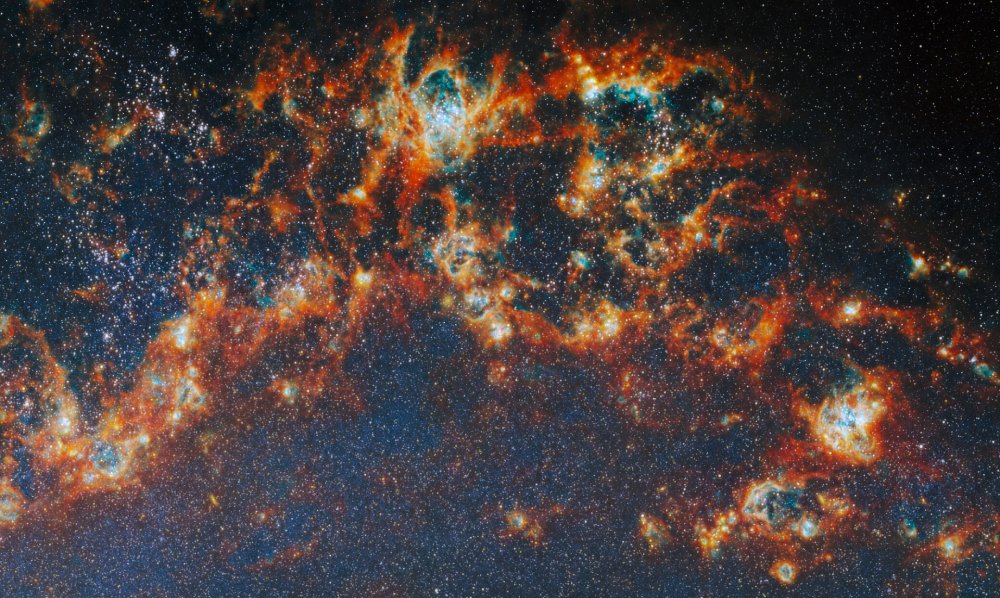
Astronomers have long known that understanding how star clusters come to be is key to unlocking other secrets of galactic evolution. Stars form in clusters, created when clouds of gas collapse under gravity. As more and more stars are born in a collapsing cloud, strong stellar winds, harsh ultraviolet radiation and the supernova explosions of massive stars eventually disperse the cloud, and their light can bear down on other star-forming regions in the galaxy. This process is called stellar feedback, and it means that most of the gas in a galaxy never gets used for star formation. Researching how star clusters develop can answer questions about star formation at a galactic scale. Now, the state of the art has been further developed with both Hubble and Webb working together to provide a broad-spectrum view of thousands of young star clusters. An international team of astronomers has pored over images of four nearby galaxies from the FEAST observing programme (#1783), trying to solve this mystery. Their results show that it is the most massive star clusters that clear away their gaseous shroud the fastest, and begin lighting their galaxy the earliest. The team identified nearly 9000 star clusters in the four galaxies in different evolutionary stages: young clusters just starting to emerge from their natal clouds of gas, clusters that had partially dispersed the gas (both from Webb images), and fully unobstructed clusters visible in optical light (found in Hubble images). With Webbs ability to peer inside the gas clouds, they were able to then estimate the mass and age of each cluster from its light spectrum. This image shows a section of one of the spiral arms of Messier 51 (M51), one of the four galaxies studied in this work, as seen by Webbs Near-Infrared Camera (NIRCam). The thick clumps of star-forming gas are shown here in red and orange, representing infrared light emitted by ionised gas, dust grains, and complex molecules such as polycyclic aromatic hydrocarbons (PAHs). Within these gas complexes, each tens or hundreds of light years across, Webb reveals the dense, extremely bright clusters of massive stars that have just recently formed. The countless stars strewn across the arm of the galaxy, many of which would be invisible to our eyes behind layers of dust, are also laid bare in infrared light. [Image description: A large, long portion of one of the spiral arms in galaxy M51. Red-orange, clumpy filaments of gas and dust that stretch in a chain from left to right comprise the arm. Shining cyan bubbles light up parts of the gas clouds from within, and gaps expose bright star clusters in these bubbles as glowing white dots. The whole image is dotted with small stars. A faint blue glow around the arm colours the otherwise dark background.]

天文學家利用詹姆斯·韋伯太空望遠鏡,結合哈伯太空望遠鏡,深入觀測四個鄰近星系中數千個年輕星團,研究它們在不同演化階段的狀態。研究結果顯示,質量較大的星團能更快速地從誕生時包覆的氣體雲中脫離,迅速清除周圍氣體,並以紫外線照亮整個星系。這讓我們更深入理解星系中的恆星形成過程,以及行星形成可能發生的位置與環境。

理解星團如何形成,是解開星系演化諸多謎團的重要關鍵。

恆星通常以星團形式誕生,當氣體雲在重力作用下塌縮時,便會形成大量新生恆星。然而,隨著恆星持續生成,強烈的恆星風、高能紫外線,以及大質量恆星最終的超新星爆炸,會逐漸驅散周圍氣體雲,使得恆星形成提前終止,而不是將所有氣體完全耗盡。當包覆星團的氣體散去後,星團發出的光也會影響星系中其他正在形成恆星的區域。這種現象稱為「恆星回饋」(stellar feedback),這個機制解釋了為何星系中的大部分氣體最終並不會真正轉化成恆星。因此研究星團的形成與演化,能幫助我們理解整個星系尺度上的恆星形成機制。

對於銀河系中距離我們較近的恆星形成區域,天文學家可以觀察到極為細緻的結構。然而,由於地球位於銀河盤面之內,實際可直接觀測的區域相當有限。藉由觀測鄰近其它星系,天文學家則能一次調查數千個恆星形成區域,分析不同演化階段的整體星團族群。

藉由詹姆斯·韋伯太空望遠鏡的紅外線波段觀測,使我們得以揭開遮蔽最年輕星團的氣體帷幕,觀察它們最初期的演化階段。

如今,隨著哈伯太空望遠鏡與詹姆斯·韋伯太空望遠鏡聯手合作,研究團隊分析了 M51、M83、NGC 628與NGC 4449等四個鄰近星系,試圖解開星團形成後,究竟需要多久才能驅散誕生時氣體雲的問題。

研究團隊在四個星系中辨識出近9,000個不同演化階段的星團,包括剛開始從氣體雲中浮現的年輕星團、已部分驅散周圍氣體的星團,以及已完全不受遮蔽、並在可見光波段中清楚觀測的成熟星團。

研究人員進一步利用光譜估算每個星團的年齡與質量。結果發現,大質量星團大約在形成後500萬年便已完全驅散周圍氣體,而較低質量星團則需約700至800萬年,才能真正脫離其誕生環境。

這項研究回答了「哪些星團能最快驅散誕生氣體雲?」這個長期未解的問題,也推進了我們對星系形成與行星形成的理解。由於大質量星團中的高溫恆星會更早產生強烈紫外線,環繞年輕恆星的原行星盤也會更早暴露於高能輻射下,降低塵埃成長與行星形成的機會。研究結果發表於《Nature Astronomy》(Pedrini et. al. 2026)。

發佈留言

發佈留言必須填寫的電子郵件地址不會公開。 必填欄位標示為 *